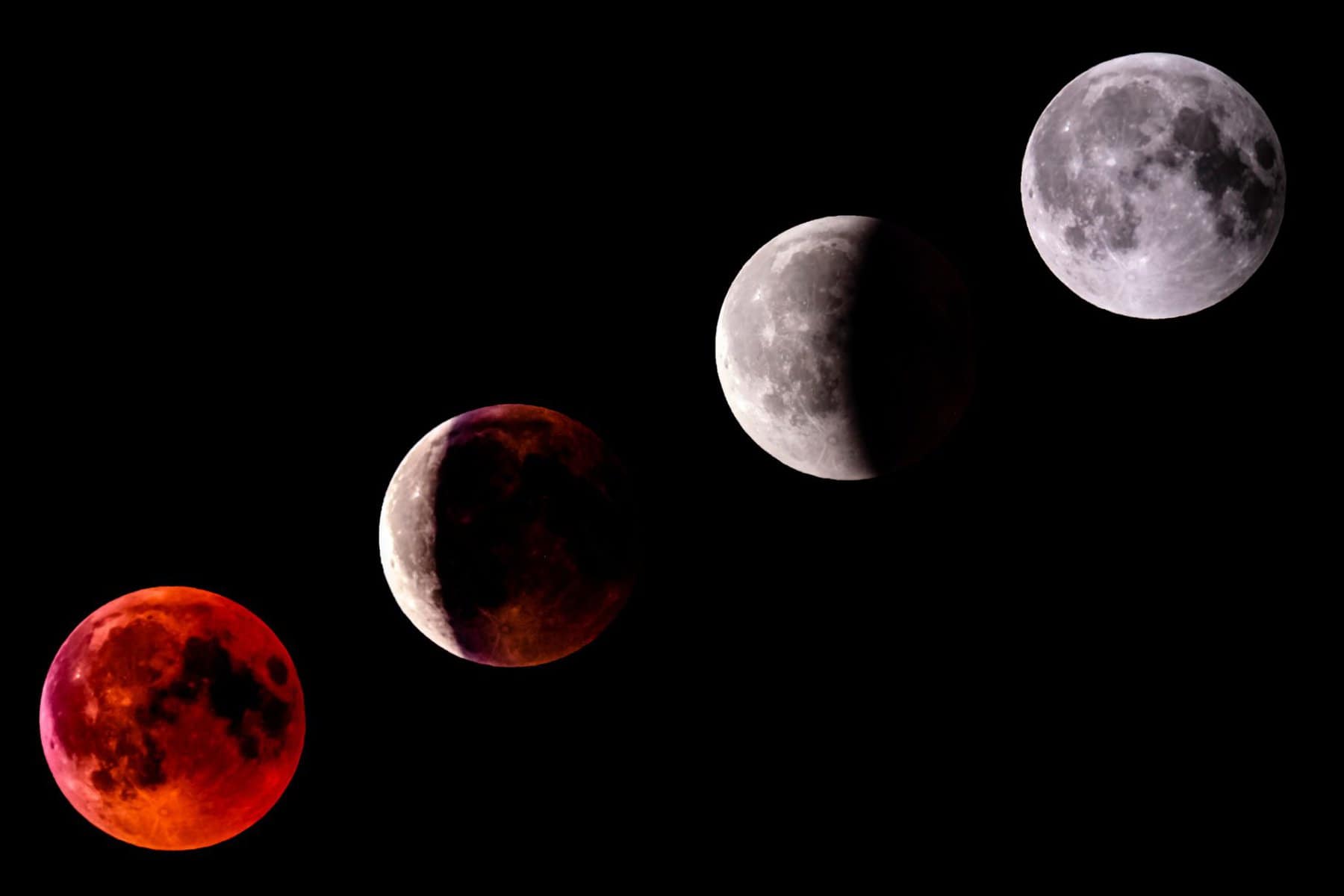
This week, we’ll get to view a partial lunar eclipse in the Atlanta skies.
Although it’s not a total eclipse, it’s a very deep partial event, with about 96% of the moon in shadow at peak eclipse.
If skies are mostly clear, you can view from home.
OR, you can head to Fernbank Science Center for a FREE viewing party — and get a close-up view through the large telescope there.
The eclipse timeline:
- The eclipse will begin at 9:23 a.m. on Thursday, August 27, 2026, when the moon enters the Earth’s faint outer shadow. (This phase is not much to look at.)
- Things get more dramatic when the partial eclipse begins at 10:33 p.m. and the dark shadow begins to cover the moon.
- Maximum eclipse arrives just after midnight, at 12:12 a.m. — so you can get to bed early enough to still be functional the next day.
- Die-hard eclipse viewers can see it through all the way, watching the partial eclipse recede until 1:51 a.m.
- The entire event concludes at 3 a.m.
We’ve got tips just below for viewing the lunar eclipse on your own, as well as some info on eclipse watch events and links to live-streams of the eclipse — just scroll down for those.
But first, some background info:
♣ A blood moon refers to a phenomenon by which the moon appears reddish or coppery in color. The red color is caused by the way the light waves scatter, and how the human eye perceives it. It’s the same effect that gives sunrise and sunset a reddish glow. The shade of red varies by the amount of dust and clouds in the atmosphere at the time.
♣ A total lunar eclipse happens at full moon when the earth, moon, and sun line up exactly, so the earth blocks light from the sun. The moon appears darkened as it passes through the shadow of the earth.
And by the way, the August full moon is also known as the “Sturgeon Moon.”
How can I see the lunar eclipse in Atlanta?

It is super simple — just go outside, look up, and take it all in. Unlike with a solar eclipse, you don’t need special equipment or eye protection. There’s no danger in looking right at the eclipse.
The best viewing conditions are clear skies, but the eclipse is long enough that you’ll be able to see some of it even if it’s partially cloudy.
The good news is, you won’t need a clear view of the horizon this time — the eclipse happens late enough in the evening that the moon will be high in the sky.
It never hurts to scout for a viewing spot ahead of time. You’ll want to find a good view to the south and southwest. The eclipse begins with the moon in the southeast sky and ends nearly due south.
The compass app on your mobile phone is a great tool to help you choose a spot.
You may want to move away from bright city lights. The darker it is where you are, the more dramatic your view. That said, it’s very likely you can watch from your own yard.
If you happen to have good binoculars, or even a small telescope, definitely use them. It would be fun to get a closer look at the moon and the lunar eclipse.
Lunar eclipse viewing events
Don’t want to go it alone?
Check out one of these lunar eclipse events, happening at science centers and observatories.
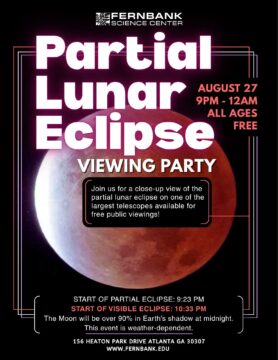
Fernbank Science Center
August 27, 2026
9 p.m. to midnight
All ages FREE
Remember that the start of the visible eclipse is at 10:33 p.m.
This event is weather-dependent.
You’ll be able to take a turn viewing the eclipse through the large telescope.
You’re also welcome to bring a blanket or chairs to settle on the lawn.
According to Fernbank’s Instagram post, there will be a food truck on site.
More info
And remember, this is Fernbank Science Center — and not the Fernbank Museum.
It’s located at:
156 Heaton Park Dr
Atlanta, GA 30307
Tellus Science Museum
August 27, 2026
10 p.m. to 2 a.m.
Museum admission fee applies
View the eclipse from the Observatory or watch a live eclipse demonstration in the Planetarium.
You can also explore the museum galleries.
Schedule
Planetarium shows at 11:30 p.m. and 12:30 a.m.
Eclipse talks at 11 p.m., midnight, and 1 a.m.
The Tellus Science Museum is located at:
100 Tellus Drive
Cartersville, GA 30120
Lunar eclipse live streams
Watch the eclipse from the comfort of your own bed!
TimeAndDate.com
Watch from their website or from their YouTube channel.
Griffith Observatory
The famed Los Angeles observatory will stream the eclipse live and you can watch live on their website. Remember the time zone is different there!
Space.com
Watch the live stream on their space blog — streaming here.
Fernbank Science Center & Planetarium / Observatory
156 Heaton Park Dr
Atlanta, GA 30307
Tellus Science Museum (Cartersville)